Guides / Idle Games
Idle Games Explained: What They Are, How They Work and Why We Play Them
 ONI Games · Published
An idle game keeps making progress while you are away. What that means, how the genre works under the hood, the main types with real examples, and how to pick a good one, from a studio that makes them.
An idle game is a game that keeps making progress when you stop playing. You set things up, the game earns and fights on its own, and when you come back there is more to spend. Your job is not fast reflexes but good decisions: what to upgrade, when to push, and when to start over stronger.
In one sentence: idle games are games about growth, where numbers go up even while you are away, and the fun is in planning how to make them go up faster.
We make idle games for Android (Idle Ronin, Idle Summoner and Idle AI Factory), so this guide shows the genre from both sides: what you see as a player and the formulas that run underneath. The numbers about other games come from their Google Play pages, collected in September 2026.
What is an idle game?
Idle games are also called incremental games, clicker games or AFK games, and the names overlap a lot. What they share is a loop of accumulation: you collect a resource, spend it on things that collect more of it, and watch the totals climb, usually exponentially. Wikipedia describes the genre by exactly that, the incremental accumulation of resources through repeated actions or automation.
The unusual part is how little the game needs you. Researchers who studied 66 idle games for the CHI 2018 conference described them as games that are left running with little player interaction, and noted that they move the player from playing to planning. The game scholar Sonia Fizek calls it delegated play: you hand the actual playing to the game and enjoy watching it work for you.
That does not make idle games mindless. A good one is a string of small economic decisions. Should you buy the cheap upgrade now or save for the expensive one that doubles everything? Should you push the next boss or farm for an hour? The game waits for your answer as long as you like.
How do idle games work?
Under the art, almost every idle game runs the same cycle:
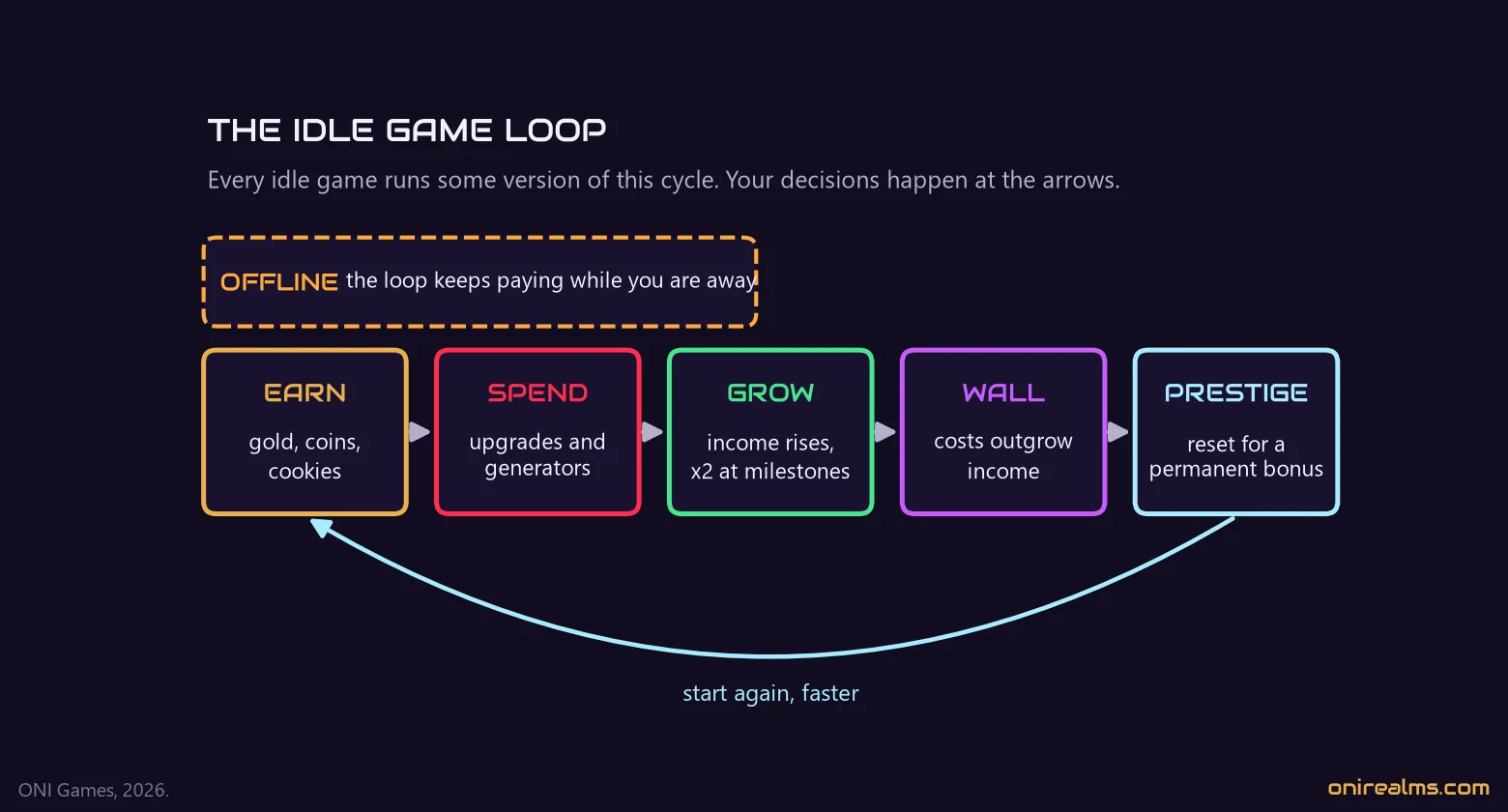
- Earn. Something produces a resource: a factory floor, a hero hitting enemies, a cookie you tap.
- Spend. You buy upgrades or new generators that raise your income.
- Grow. Income rises, often in jumps. In Idle AI Factory, reaching floor levels 10, 25, 50, 75 and 100 doubles that floor's production each time.
- Hit a wall. Costs grow faster than income, so progress slows down. This is on purpose.
- Prestige. You reset most of your progress in exchange for a permanent bonus, and the next run goes faster and further. Games call it rebirth, ascension or reboot.
Offline earnings keep the loop turning while you are away, and events, quests and collections give you extra goals on top.
Why costs grow faster than income
The wall is simple maths. Upgrade costs in idle games usually grow exponentially: each purchase costs a fixed percentage more than the last. In Idle Ronin a unit's level-up cost grows by 14% per level up to level 300, then by 12.5% and later 11.5%. In Idle AI Factory each factory level asks for 1.8 times as many coins as the one before. Income, meanwhile, grows in steps, through multipliers and milestones. Exponential costs always catch up with income sooner or later, and the moment they do is the wall.
Designers have written openly about this maths. Anthony Pecorella, who produced the mobile version of AdVenture Capitalist, explains the core idea in his series The Math of Idle Games: costs grow exponentially while production grows more slowly, and that gap is what shapes the whole game. In AdVenture Capitalist, for example, each Lemonade Stand costs 7% more than the one before. The series is the best free introduction to the genre's design if you want to go deeper.
Why the numbers get so big
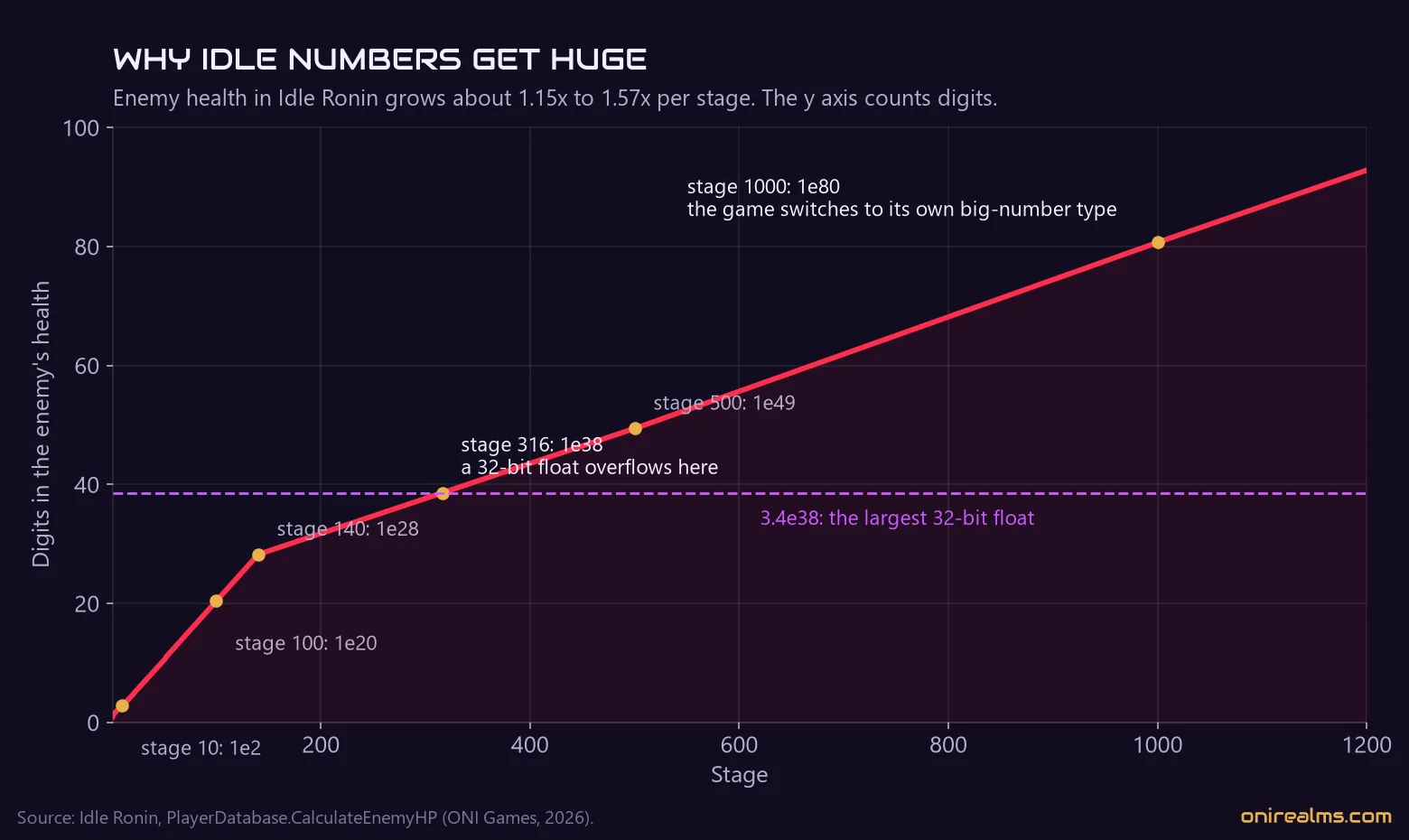
Exponential growth also explains the famous huge numbers. Enemy health in Idle Ronin grows between 1.15x and 1.57x per stage. By stage 140 an enemy has about 1e28 health, a 1 with 28 zeros, and by stage 316 it would no longer fit in the kind of number most game code uses. That is why idle games invent their own notation (K, M, B, then aa, ab or scientific notation) and their own number types.
Idle, incremental and clicker games: what is the difference?
The three words are used loosely, but they lean in different directions:
| Term | Where the focus is | Examples |
|---|---|---|
| Clicker | you tap or click to earn, especially early on | Cookie Clicker, Tap Titans 2, Clicker Heroes |
| Idle | the game earns without you, including while closed | Idle Miner Tycoon, AFK Arena, Egg, Inc. |
| Incremental | layers of systems that unlock one after another | Antimatter Dimensions, Exponential Idle |
Most modern games mix all three: you tap a lot in the first minutes, automate everything within an hour, and discover new layers for weeks. We go through the differences, with more examples, in idle vs incremental vs clicker games.
The main types of idle games
Idle mechanics now sit under many themes. These are the big groups on Google Play, with install counts as the store showed them in September 2026:
| Type | What you do | Well-known examples on Google Play |
|---|---|---|
| Idle tycoon | build and upgrade a business that runs itself | Idle Miner Tycoon (100M+), Idle Lumber Empire (100M+), Idle Bank Tycoon (10M+), AdVenture Capitalist (10M+) |
| Idle RPG / AFK RPG | build a team of heroes that fights on its own | AFK Arena (10M+), Idle Heroes (10M+), Legend of Slime (10M+) |
| Clicker RPG | tap to attack, heroes and pets add damage | Tap Titans 2 (10M+), Clicker Heroes (5M+), Idle Slayer (5M+) |
| Incremental / number games | unlock layer after layer of systems | Antimatter Dimensions (1M+), Exponential Idle (1M+), Revolution Idle (500K+) |
| Simulation and evolution | grow a farm, a planet or a species | Egg, Inc. (10M+), Cell to Singularity (10M+) |
| Idle MMO and skilling | train many skills, sometimes with other players | IdleOn (5M+), Melvor Idle (500K+) |
Idle tycoons
The biggest group by installs. You run a mine, a bank, a supermarket or a factory. Every part of the business has a level, and managers or automation keep it working while you are away. Our Idle AI Factory is one of these, with robots instead of workers.
Idle RPGs and AFK RPGs
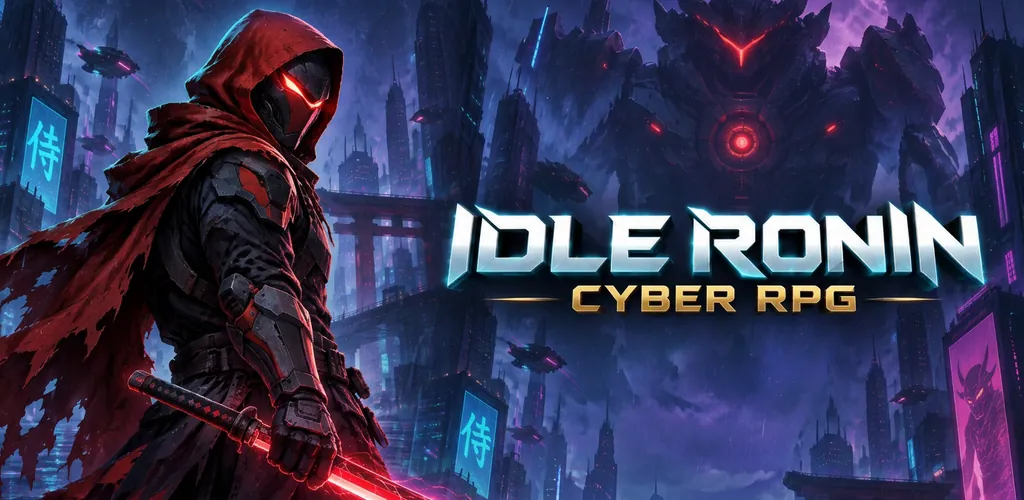
Here the thing that runs on its own is a battle. A hero or a squad fights through stages, gold and gear drop, and bosses mark the walls. Many of the most popular ones are hero collectors, where summoning new heroes is a big part of the game. Idle Ronin (cyberpunk, a squad of cyborgs) and Idle Summoner (pixel art, monster summoning) are ours. Our full guide to what an idle RPG is goes deeper.
Clickers and tappers
The oldest style: tapping is your main source of damage or money at first, and the idle part takes over as you unlock helpers. Tap Titans 2 and Clicker Heroes made this the standard on phones.
Incremental and number games
The purest form, closest to the genre's roots in browser games. The art is minimal, and the fun is in discovering that the game you thought you understood has three more layers. Antimatter Dimensions and Exponential Idle are two of the highest rated games in the whole genre on Google Play, at 4.77 and 4.73 stars.
What happens when you are offline?
Offline progress is the feature that defines the genre. The game remembers when you left, and when you return it pays you for the time away, usually a share of your normal income and only up to a cap. The rules differ a lot between games:
- Idle Ronin replays the fight for up to 8 hours, so your squad can clear stages while you sleep.
- Idle AI Factory pays 10% of your income for 2 hours at the start, and research raises that to 40% for 8 hours.
- Idle Summoner pays 20% of your invasion income for up to 24 hours, plus a welcome-back gold bonus.
We explain the formula, the reasons for caps and how to get more in how offline earnings work.
Prestige: why idle games ask you to start over
Sooner or later every idle game offers you a deal: give up your progress and get a permanent bonus. It sounds painful, and the first time it is. But the bonus makes the next run so much faster that you pass your old record quickly, and the wall that stopped you becomes a speed bump.
Our three games show how differently it can be done:
- Idle Ronin (Rebirth, from stage 50): you get Rebirth Tokens, and each token you hold adds 10% ATK to all your units. Tokens can also be spent on Guardians, permanent helpers.
- Idle Summoner (rebirth, from stage 50): your player level jumps to the stage you reached, and each player level adds 1% damage to all your monsters.
- Idle AI Factory (Factory Reboot, from level 40): you earn AI Cores, more for higher levels, for stars and in later worlds, and spend them on research.
When to reset is one of the most discussed questions in every idle game community, and we answer it with real numbers in prestige, rebirth and ascension explained.
Why are idle games so satisfying?
Idle games get called addictive a lot. Part of the pull is simple: numbers going up is pleasant, and an idle game gives you a steady stream of small rewards without asking for much.
The research adds two less obvious reasons. The CHI 2018 study found that idle games shift your attention from moment-to-moment play to planning, so the game fits around your day instead of taking it over. Fizek's idea of delegated play explains the rest: there is real enjoyment in watching something work for you, in the same way people enjoy watching a machine or a garden grow.
There is also a designed side. Daily rewards, streaks and notifications bring you back, and offline caps set how often. Academic critics have pointed out that some idle games use these hooks to push ads and purchases. In a 2024 paper in the journal Replay, Justin Buergi argues that the genre started out cozy and that some developers turned players' impatience into a business. Both things are true: the genre can be relaxing, and some games in it are built to squeeze. Knowing the tricks helps you pick the first kind.
Are idle games bad for you?
For most people, no more than any other hobby. Idle games are low-stress, you can play them in short sessions, and you can stop without losing anything. The risks are the ones that come with any free game:
- Checking too often. Turn notifications off if the game pings you more than you like. A game with an 8 or 24-hour offline cap does not need you more than once or twice a day.
- Spending. Many idle games sell boosts and currency. Decide on a budget before you start, and look at the price range of in-app purchases on the store page: AFK Arena lists items up to $299.99, while Exponential Idle stops at $3.99.
- Ads. Check whether the store page says Contains ads, and whether the ads you see are optional rewards or forced breaks.
Do idle games ever end?
Most mobile idle games are built to go on forever, with events, new worlds and new layers added in updates. A few are designed with a real ending. Candy Box!, A Dark Room and Universal Paperclips are the classic examples, and they are worth playing for exactly that reason: you get the pleasure of the genre and a finish line.
How to choose a good idle game
After years of making and playing them, this is what we look at before installing one:
- Offline rules. Does the game say how long it keeps earning while you are away? A cap that fits your day matters more than any other feature.
- The ad label. Google Play shows Contains ads on games with ads. Rewarded videos you choose to watch are a very different thing from ads that interrupt you.
- The in-app purchase range. The store page lists the cheapest and most expensive item. A top price in the hundreds tells you who the game is built for.
- Recent updates. Look at the Updated on date. An idle game that stopped getting updates years ago can still be good, but it will not grow.
- Number of ratings, not only the average. A 4.8 from 300 ratings says less than a 4.5 from 300,000.
- Cloud save. Idle progress is months of work. Make sure it survives a new phone; here is how to move game progress to a new Android phone.
- Offline play. Many idle games run without a connection, which makes them great for flights and commutes. Some online ones do not.
Idle games by ONI Games
We are a small studio, and idle games are most of what we make. All of them are free on Google Play, with ads and optional purchases, and all of them run offline:
- Idle Ronin: Cyber RPG: a cyberpunk idle RPG where a Ronin and a squad of cyborgs fight on their own, with a 300-floor Neon Tower and dungeons.
- Idle Summoner: Pixel RPG: a pixel art idle RPG built around summoning and merging monsters, invasions and rebirth.
- Idle AI Factory: Robot Tycoon: an idle tycoon where robots run a factory across three worlds, with research and collectible robots.
We also make Block Brain, a block puzzle game, for when you want to do the playing yourself.
FAQ
Are idle games offline?
Many are. The core loop of most idle games works without a connection, and offline progress is calculated from your phone's clock. Games with multiplayer features, leaderboards or server events need the internet for those parts.
How popular are idle games?
Very. On Google Play, Idle Miner Tycoon alone shows more than 100 million installs, and several idle tycoons and idle RPGs show more than 10 million each. Our study of the genre on Google Play looks at hundreds of them.
What was the first idle game?
Progress Quest, released in 2002 as a parody of role-playing games, is usually called the first. The genre went mainstream in 2013 with Cookie Clicker.
What is the point of an idle game if it plays itself?
The point is the planning. The game handles the repetitive part, and you make the decisions that shape how fast everything grows. For many players that is a relaxing kind of play that fits into short breaks.
Can I play idle games without ads?
Yes. Some idle games have no ads at all, some sell a no-ads option, and many only show ads you choose to watch for a reward. The Contains ads label on the store page is the first thing to check.
New to the words people use in idle game communities? Our idle games glossary explains them, and our idle game tips help you progress faster without playing longer.
Sources
- Alharthi, Alsaedi, Toups Dugas, Tanenbaum and Hammer, Playing to Wait: A Taxonomy of Idle Games, CHI 2018.
- Sonia Fizek, Interpassivity and the Joy of Delegated Play in Idle Games, Transactions of the Digital Games Research Association, 2018.
- Anthony Pecorella, The Math of Idle Games, Part I, 2016.
- Justin Buergi, Idle Games: A Cozy Genre Turned Exploitative, Replay. The Polish Journal of Game Studies, vol. 12 no. 1, 2024.
- Incremental game, Wikipedia.
- Google Play store pages (US, English), checked September 25, 2026: install counts, ratings, ad labels and in-app purchase ranges.
- ONI Games game code: Idle Ronin (PlayerDatabase.cs, Medal.cs), Idle AI Factory (Balance.cs, Economy.cs), Idle Summoner.