 ONI Games · Published
 From AFK to x2: 75 words idle and incremental game players use, explained in plain English, with examples from real games and links to the full guides.
Idle game communities have their own vocabulary, and a lot of it is never explained in the games. This glossary covers the 75 terms you are most likely to meet in idle, incremental, clicker and AFK games, in alphabetical order. Where a term needs more than a paragraph, we link to the full guide.
Most important five: offline earnings, prestige, multiplier, wall and soft cap. Understand those and you understand how almost every idle game is built.
A to C
- Active play: playing with the game open and tapping, as opposed to letting it run. Active play usually earns more per minute than being away.
- AFK: away from keyboard. In games it means progress that happens while you do nothing; an AFK game is an idle game, usually a hero collector. See what is an AFK game.
- Ascension: another name for prestige, used by Cookie Clicker among others.
- Auto-progress: the game moves you to the next stage by itself when you win. Turning it off lets you farm a stage you can beat.
- Automation: anything that plays for you, such as managers in tycoons or helpers in clickers.
- Boost / booster: a temporary multiplier, like double income for 30 minutes, often from a video or a purchase.
- Boss timer: the time you have to beat a boss. In Idle Ronin it starts at 30 seconds, and failing costs nothing but a retry.
- Breakpoint: a threshold where a small upgrade makes a big difference, such as killing an enemy in one hit instead of two.
- Bulk buy: buying several levels at once (x10, x100 or MAX). Idle Ronin has x1, x5 and MAX.
- Clicker: a game where tapping earns resources. See idle vs clicker.
- Cloud save: a copy of your progress stored online, usually with Google Play Games, so it survives a new phone. See how to transfer game progress.
- Cooldown: the waiting time before a skill or reward can be used again.
- Crit (critical hit): a hit that deals extra damage, based on crit chance and crit damage.
- Currency, hard and soft: soft currency (gold, cash) is earned all the time; hard or premium currency (gems, diamonds) is rare and also sold for money.
D to F
- Daily quest: a small task that resets every day, like defeating 150 enemies. See why games have daily rewards.
- Diminishing returns: each extra level of an upgrade gives less than the last.
- DPS: damage per second, the main measure of strength in idle RPGs.
- Dungeon: a separate mode, often limited by keys per day, that pays special rewards. Idle Ronin's three dungeons each give 2 keys a day.
- Early game / mid game / late game: rough phases of a game. Advice for one phase is often wrong for another.
- Efficiency: the share of your normal income you get while away, from a few percent to 100%.
- End game: the point where the main content is done and progress comes from long goals, events and rankings.
- Energy / stamina: a resource that limits how much you can play before waiting. See energy in mobile games.
- Event: limited-time content with its own rewards, such as Idle AI Factory's weekend events.
- Exponential growth: growth by a fixed percentage each step, which is why numbers in idle games explode.
- F2P: free to play. Also used for players who never pay.
- Farming: repeating an easy stage or mode for resources instead of pushing forward.
G to L
- Gacha: random draws for characters or items, paid with currency. See gacha, pity and drop rates.
- Generator: anything that produces a resource: a building, a worker, a factory floor, a hero.
- Grind: progress that takes a lot of repetition.
- Guild / clan: a group of players who share goals and rewards.
- Idle: progress without you. See idle games explained.
- Idle RPG: an RPG where battles run on their own. See what is an idle RPG.
- Income per second: how much you earn each second, often shown at the top of the screen.
- Incremental: a game built on accumulating resources and unlocking new systems.
- Layer: a new level of the game unlocked later, often a new currency or a second prestige.
- Leaderboard: a ranking of players, weekly or all-time.
- League: a group of players who compete for a week, with promotion and demotion. Block Brain puts players in groups of up to 30.
- Log scale: a way of drawing numbers where each step is ten times the last, the only sensible way to chart idle game growth.
- Loot: items dropped by enemies or chests.
M to O
- Manager: a helper who runs part of a business automatically in tycoon games.
- Merge: combining two identical items into a better one.
- Meta: the currently strongest strategy or team, as agreed by the community.
- Milestone: a level where an upgrade gives an extra bonus. Idle AI Factory doubles a floor's production at levels 10, 25, 50, 75 and 100.
- Monthly card: a purchase that pays a small reward every day for 30 days.
- Multiplier: a bonus that multiplies income or damage, like x2. Multipliers stack by multiplying, which is why they grow so fast.
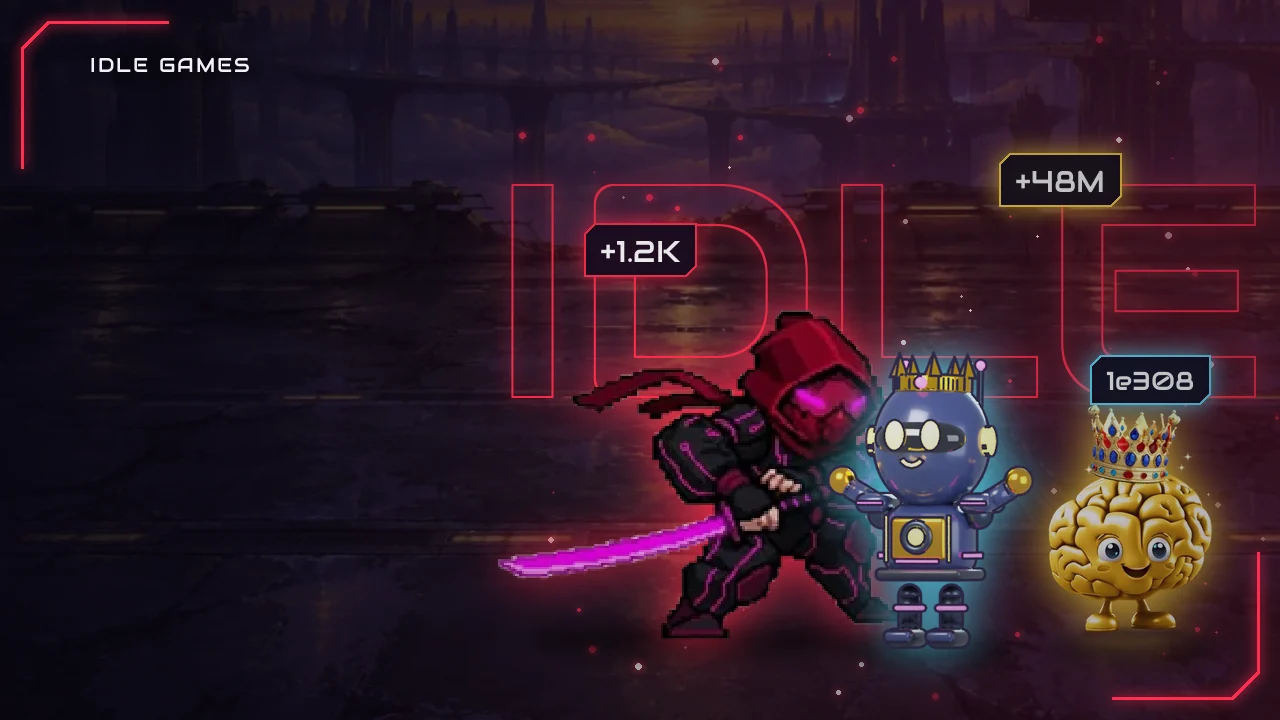
- Notation: how a game writes huge numbers: K, M, B, T, then letters (aa, ab) or scientific notation (1e308).
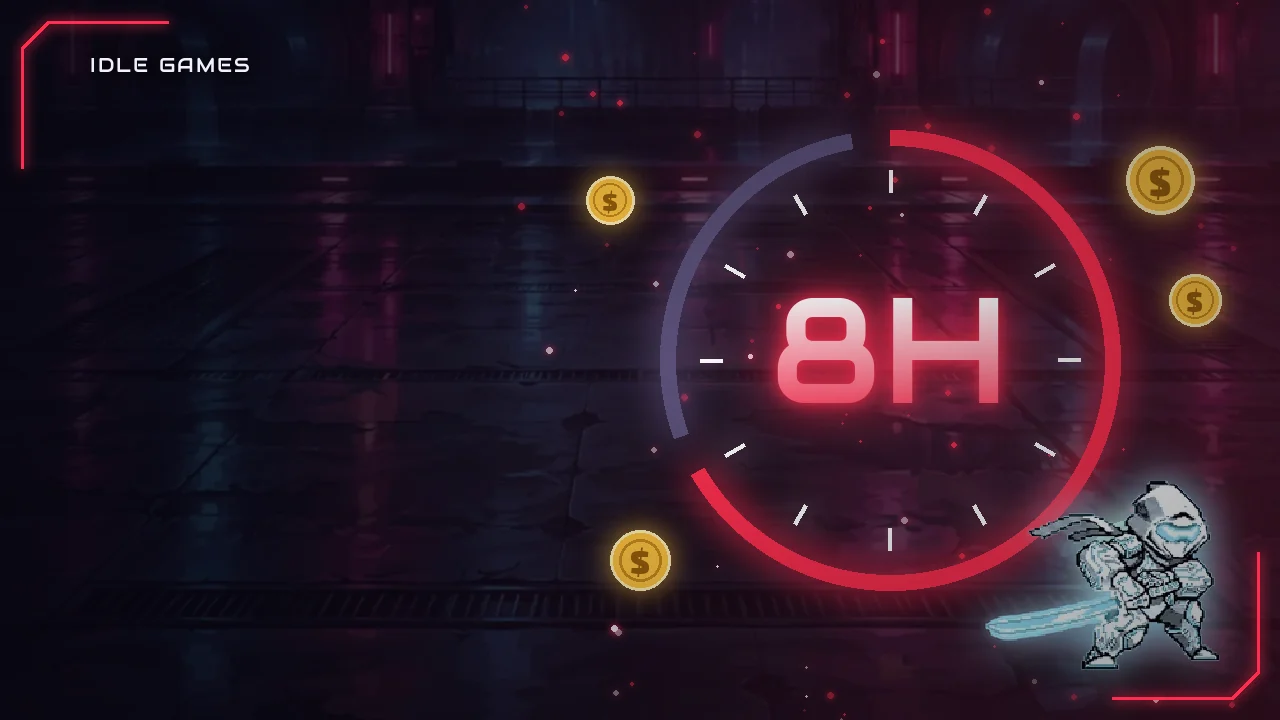
- Offline cap: the longest time away a game pays for. Idle Ronin's is 8 hours. See how offline earnings work.
- Offline earnings / offline progress: what the game pays you for the time away.
P to R
- Pass (battle pass): a season of rewards unlocked by playing, with a free and a paid track. See how battle passes work.
- Pay-to-win: a game where money buys power that free players cannot reach.
- Pity: a guarantee in gacha systems that you get a rare item after a certain number of draws.
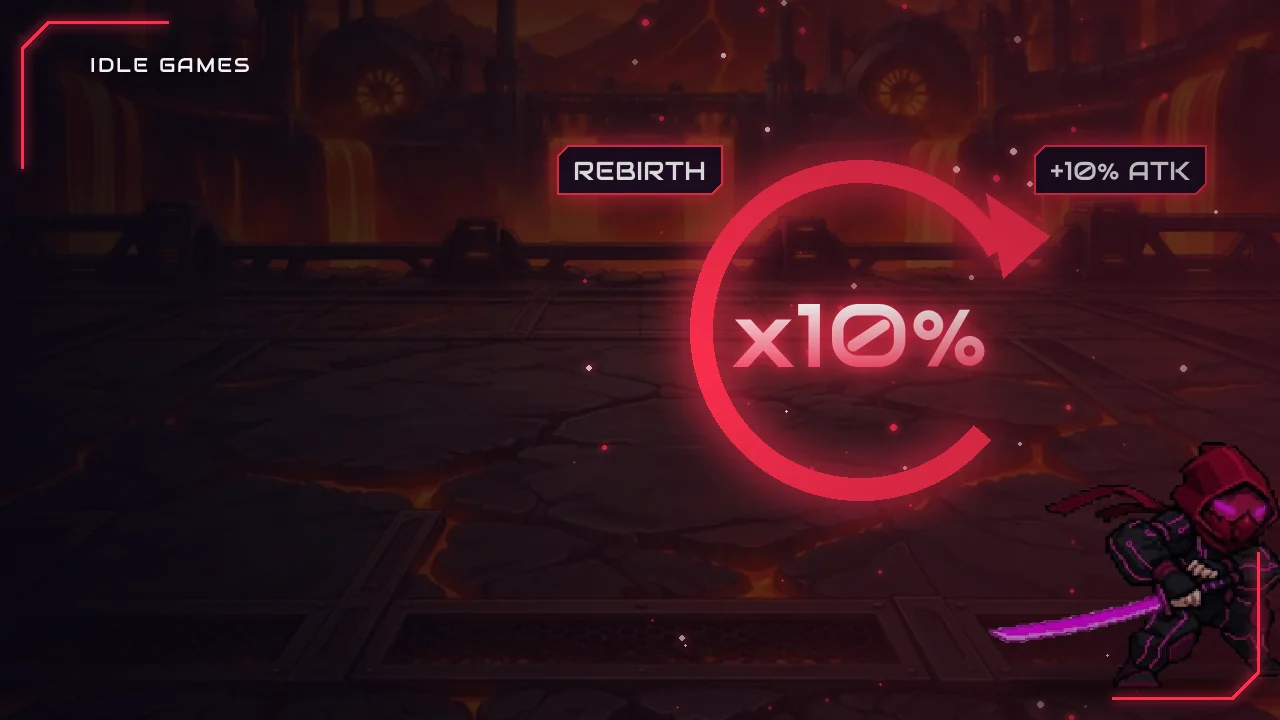
- Prestige: resetting your progress for a permanent bonus. See prestige, rebirth and ascension.
- Prestige currency: what a prestige pays, such as Rebirth Tokens in Idle Ronin or AI Cores in Idle AI Factory.
- Push: trying to go as far as possible, the opposite of farming.
- Rarity: the tier of a character or item: common, rare, epic, legendary.
- Rebirth: another name for prestige.
- Research: permanent upgrades bought with a special currency, like Idle AI Factory's AI Research.
- Rewarded ad: a video you choose to watch for a reward. See rewarded vs interstitial ads.
- Run: the stretch of play between two prestiges.
S to T
- Set bonus: an extra bonus for using several items or units of the same set together.
- Soft cap: a point where growth deliberately slows down without stopping.
- Speedrun: racing through early stages after a prestige.
- Stage / wave: a unit of progress in idle RPGs. In Idle Ronin every stage has 10 waves and the tenth is a boss.
- Starter pack: a cheap first purchase offered to new players, often for a limited time.
- Summon: drawing a new character, usually with gacha odds.
- Tap / tapping: actively touching the screen to earn or attack.
- Tier list: a community ranking of characters or items from strongest to weakest.
- Time warp / time skip: an item that instantly grants a chunk of production, such as Idle Ronin's Time Capsules.
- Tower: an endless mode where each floor is harder, often with a ranking. Idle Ronin's Neon Tower has 300 floors.
U to Z
- Unlock: a feature that opens at a certain stage or level, like Rebirth at stage 50.
- Upgrade: anything you buy to get stronger or earn more.
- VIP: a paid status or points system that unlocks bonuses.
- Wall: a point where progress nearly stops because costs have outgrown income. The usual answer is to prestige.
- Whale: a player who spends a lot of money. A tiny share of players, but a big share of revenue in free games.
- x2 / x5: the common multipliers on reward buttons, usually for watching a video.
Sources
- ONI Games game code for the examples from Idle Ronin, Idle AI Factory and Block Brain, September 2026.
- Incremental game, Wikipedia.