Guides / Idle Games
How Idle Game Progression Works: Costs, Multipliers and Walls
 ONI Games · Published
Why every upgrade costs more than the last, why progress slows to a wall, and how milestones and multipliers break through it, with real cost curves from two idle games we made.
Idle game progression is a race between two curves: what things cost and what they give you. Costs grow by a fixed percentage with every purchase, which is exponential. The power you get back grows more slowly, in steps. Early on you win the race easily; later the costs pull ahead, progress slows, and you reach a wall. Milestones, multipliers and prestige are how you break through.
The rule behind every idle game: cost of the next level = base cost x growth^level. The growth factor looks small, often around 1.07 to 1.15 per purchase, and has huge consequences.
Why every upgrade costs more
If every upgrade cost the same, you would buy everything in a day. So idle games raise the price of each level by a percentage. AdVenture Capitalist's lemonade stands, for example, cost 7% more each, as its designer Anthony Pecorella explains in The Math of Idle Games. Our own numbers:
| Game | What | Cost growth |
|---|---|---|
| Idle Ronin | unit upgrade, up to level 300 | x1.14 per upgrade |
| Idle Ronin | unit upgrade, 300 to 1000 | x1.125 per upgrade |
| Idle Ronin | unit upgrade, above 1000 | x1.115 per upgrade |
| Idle AI Factory | factory level | x1.8 per level |
| Idle AI Factory | AI Research | x1.3 to x1.8 per level |
Notice that Idle Ronin's growth slows down at level 300 and again at 1000. That is a designer's way of stopping costs from running away completely in the long game.
Why your power grows more slowly
Here is the other side of the race, from Idle Ronin. A unit needs five upgrades to gain a level. Each level multiplies its ATK by 1.4, while the five upgrades together cost 1.14^5, about 1.93 times as much as the previous five. So once a unit has a few levels, every level costs about 38% more per point of ATK than the one before.
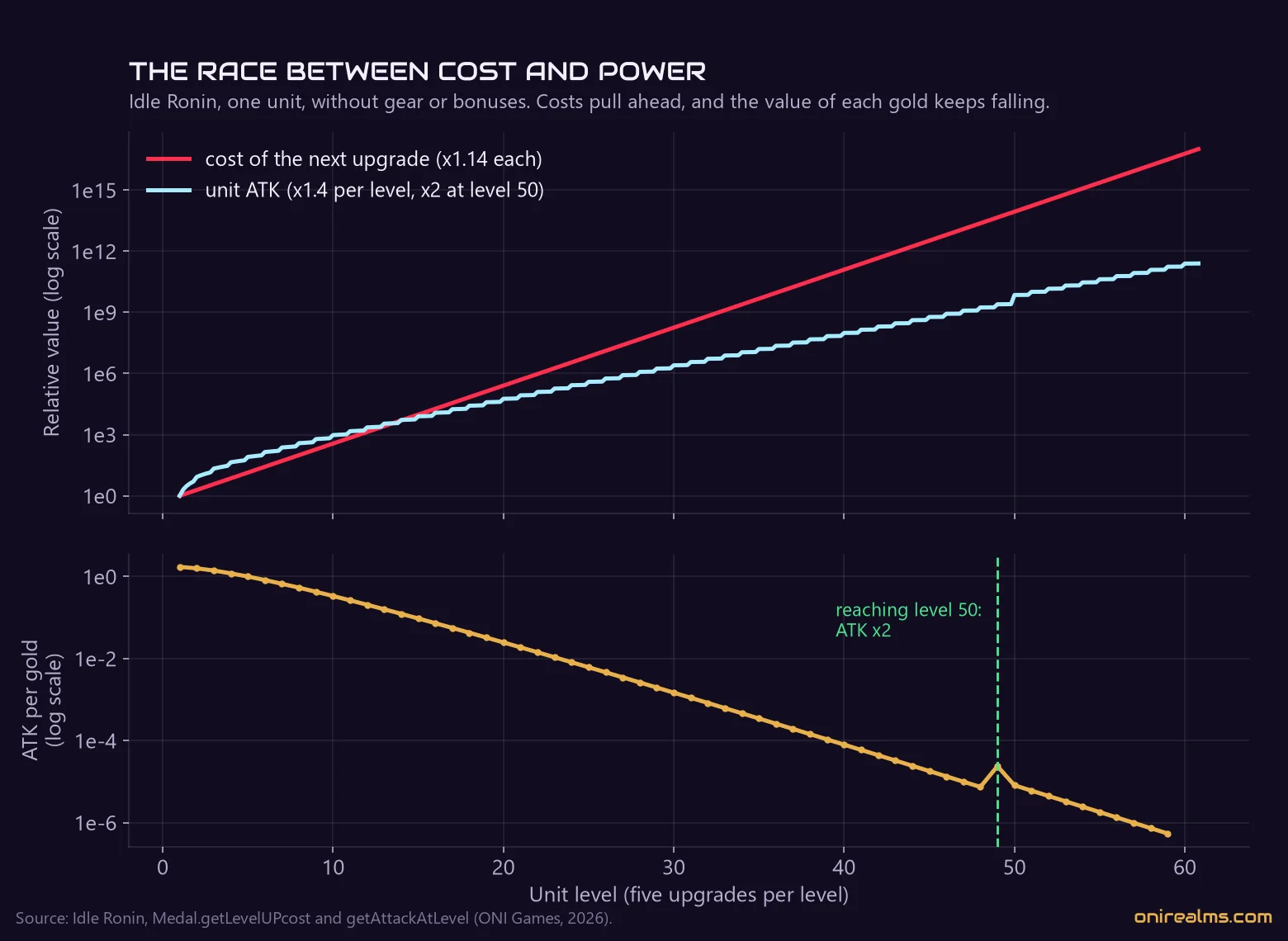
That is the wall, in one chart. The value of each upgrade keeps falling until something changes the equation.
Milestones: the steps that break walls
The most common fix is a milestone: at certain levels, an upgrade gives a big extra multiplier. In Idle Ronin, a unit's ATK doubles at level 50, quadruples at level 100 and keeps climbing every 50 levels. In Idle AI Factory, a floor's production doubles at levels 10, 25, 50, 75 and 100. On the chart, milestones are the sudden jumps in value per gold.
This is why the best idle game players push for milestones: a few levels that reach one are worth more than many levels anywhere else.
Multipliers stack by multiplying
Idle games give you bonuses from many places: gear, skins, research, prestige currency, pets. Most of them multiply each other rather than add. Two x2 bonuses give x4, not x3; ten +10% bonuses give about x2.6, not x2. That is why late-game numbers explode, and why a small new multiplier source can matter a lot more than it looks.
Where walls come from, and how games move them
A wall is the point where your income can no longer buy meaningful upgrades in reasonable time. Designers place them on purpose, because walls give the game its rhythm:
- Early game: costs are low, everything is affordable, progress is fast.
- First wall: the exponential costs catch up. Players look for milestones and new systems.
- Prestige: a reset with a permanent multiplier moves the whole cost curve in your favor.
- New layers: later systems (research, gear, a second prestige) add new multipliers so the next wall can be broken too.
Bosses do the same job in idle RPGs. In Idle Ronin, a boss has 6 times the health of its stage's normal enemies, and 10 times on stages ending in 4 or 9, which is why those stages feel like walls.
How to use this as a player
- Spend where the gain per coin is highest. Games that show the ATK or income the next upgrade adds make this easy; compare it with the cost.
- Aim for milestones. Save up to reach the next x2 instead of spreading gold thinly.
- Look for new multiplier sources. A new system usually beats another level of an old one.
- Prestige when the value per coin has collapsed. See prestige, rebirth and ascension explained.
FAQ
Why do idle games slow down?
Because costs grow exponentially and your power grows more slowly. Eventually each upgrade gives too little for its price, and progress slows to a wall until you find a milestone, a new multiplier or a prestige.
What is a good cost growth rate for an idle game?
There is no single answer. AdVenture Capitalist's lemonade stands grow 7% per purchase and Idle Ronin's units 14%. What matters is how fast the rewards grow in return.
What is a milestone in idle games?
A level where an upgrade gives an extra multiplier, like x2 production at level 25. Reaching one can feel like breaking through a wall.
Sources
- ONI Games game code: Idle Ronin (Medal.getLevelUPcost, getAttackAtLevel, PlayerDatabase) and Idle AI Factory (Balance.cs, Lvl.cs), September 2026.
- Anthony Pecorella, The Math of Idle Games, Part I, 2016.