Guides / How Mobile Games Work
How Free Mobile Games Make Money: A Developer's Honest Guide
 ONI Games · Published
Free games earn from in-app purchases, ads and passes, and a tiny share of players pays most of the bills. How each model works, where a purchase actually goes, and how to spot fair and unfair games.
Free mobile games make money in three ways: by selling things inside the game (in-app purchases), by showing ads, and by selling passes or subscriptions. Most free games do more than one. Because only a small share of players ever pays, every free game is designed around one question: how do we earn enough from the few who pay and the many who watch ads, without driving anyone away?
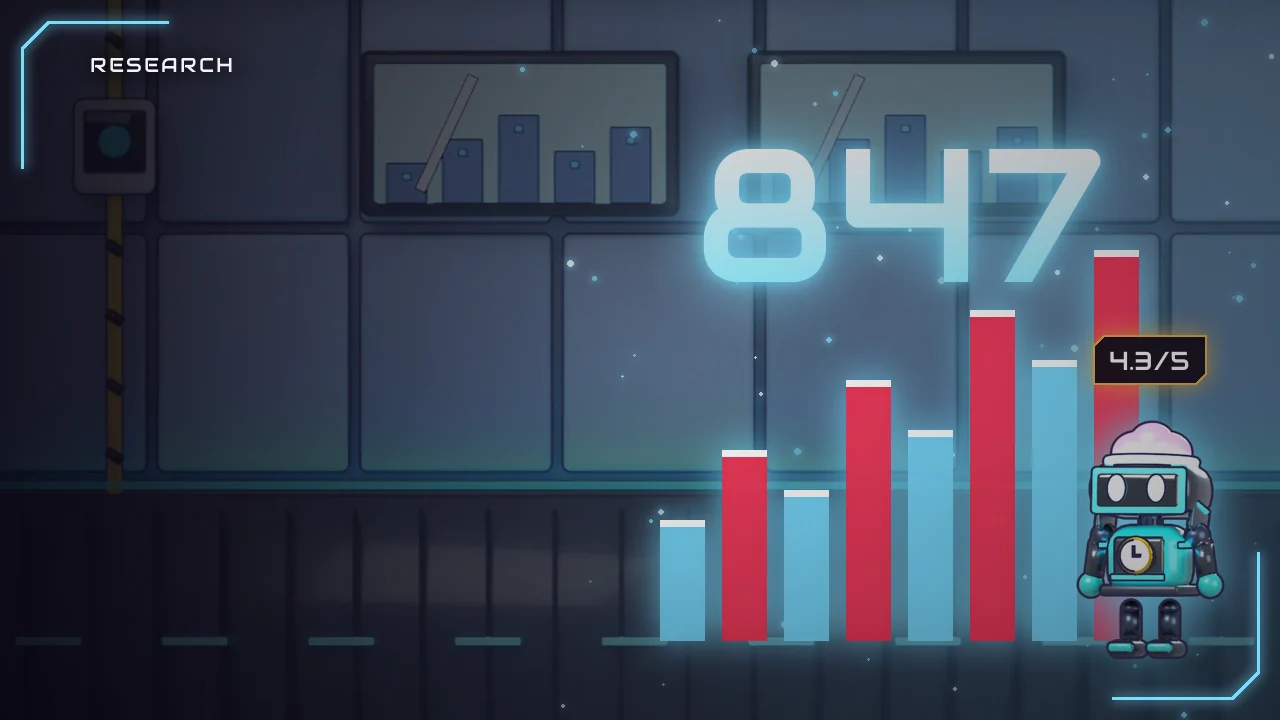
We make free games ourselves, so this guide shows the business from the inside, with real numbers from our own games and from a study of 847 idle games on Google Play.
The short version: in-app purchases bring in most of the money in most free games, ads earn a little from every player, and passes sit in between. In our Google Play study, 95% of idle games sold in-app purchases, 88% showed ads and 85% did both.
The three ways free games earn money
1. In-app purchases
An in-app purchase is anything you buy inside the game through Google Play: a pack of gems, a bundle, a character, an ad-free upgrade. Google Play splits them into two kinds:
- Consumables are used up: coins, gems, energy, boosters. You can buy them again and again.
- Non-consumables are bought once and kept forever: No Ads, a premium upgrade, a permanent bonus. They come back automatically if you reinstall with the same Google account.
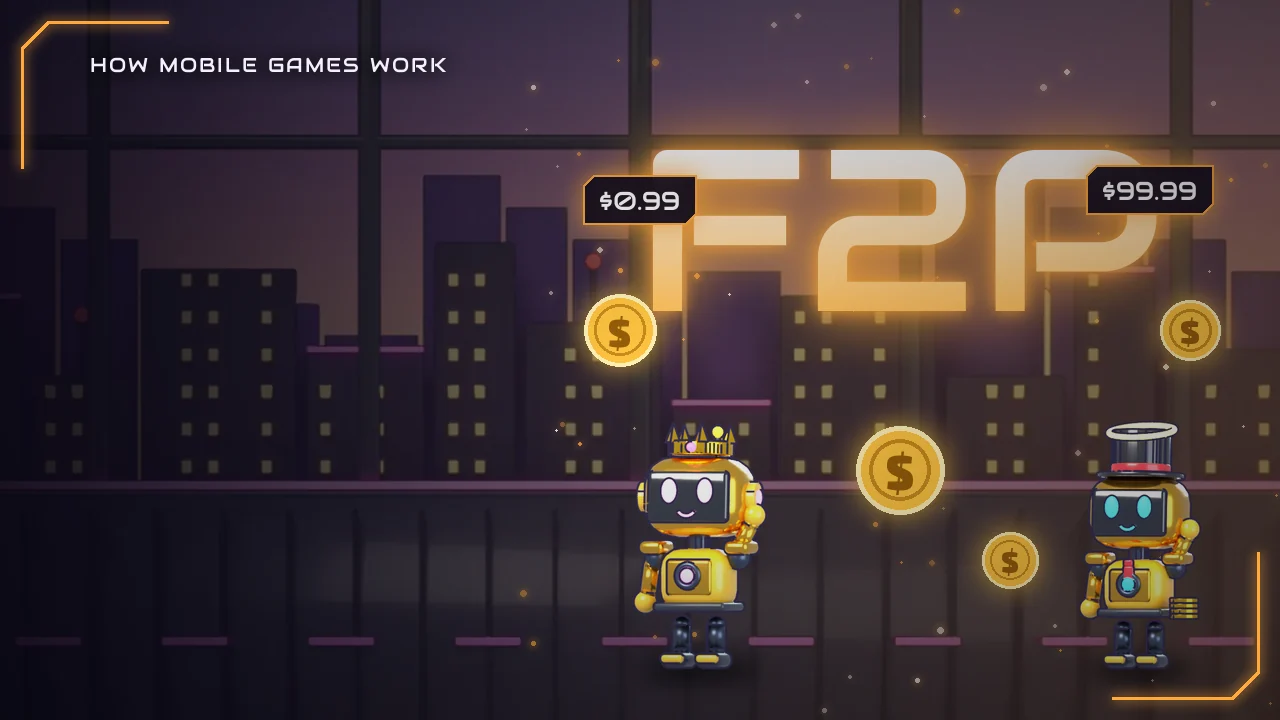
The store page shows the price range of a game's items. In our study the cheapest item cost $0.99 or less in 69% of idle games, and the most expensive cost $99.99 or more in 60% of them.
2. Ads
Ads earn a small amount every time one is shown, paid by the advertiser through an ad network such as Google AdMob. How much depends on the ad format, the player's country and the season, so a game earns more from an ad shown in the US than from the same ad shown elsewhere. There are three main formats:
- Rewarded video: you choose to watch it and get something in return, like double offline income.
- Interstitial: a full-screen ad at a break in the game, which you can close after a few seconds.
- Banner: a small strip, usually at the bottom of the screen.
We explain what each one means for you, and the rules Google sets for them, in rewarded vs interstitial ads.
3. Passes and subscriptions
A battle pass is a season of rewards you unlock by playing, with a free track for everyone and a premium track you buy. Some games also sell monthly cards: pay once, collect a daily reward for 30 days. Both turn a one-off purchase into a regular one. Our guide to how battle passes work shows the maths of a real one.
Who actually pays in free games?
Very few players. The best-known numbers come from the analytics company Swrve, which looked at tens of millions of players of free mobile games in January 2014: only 1.5% of the players active that month bought anything, and just 0.15% of players brought in half of all purchase revenue. Later reports found much the same pattern.
That is why the industry talks about "whales", the rare players who spend a lot, and why so many games sell $99.99 packs. It is also why ads matter: they are the only way a game earns anything from the 98% of players who never pay.
For you as a player, this is mostly good news. It means a well-made free game can be enjoyed completely free, because the business does not depend on you personally paying.
Where the money from a purchase goes
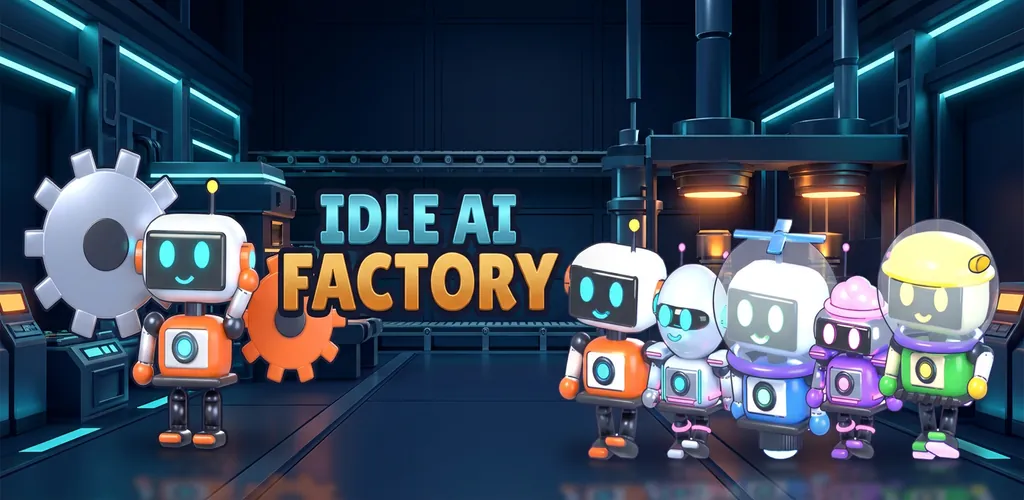
When you pay for something in a game, the developer receives much less than the price. Here is a real example from our own game, the Mega Bundle in Idle AI Factory, which costs 9.99 euros in the eurozone:
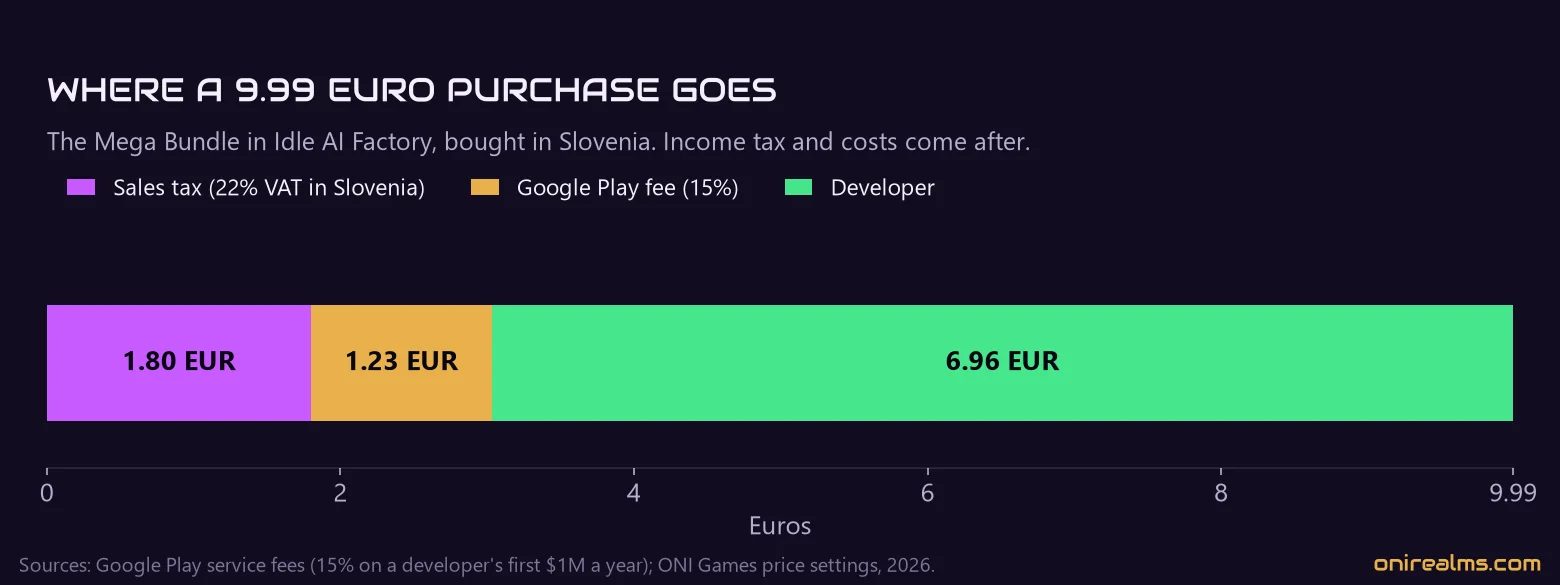
- Sales tax comes first. Prices on Google Play include the buyer's local VAT or sales tax. For a buyer in Slovenia (22% VAT), 1.80 euros of the 9.99 is tax, leaving 8.19.
- Then Google's service fee. Google Play charges 15% of a developer's first $1 million of earnings each year and 30% above that, and 15% on auto-renewing subscriptions. Google has also introduced separate, typically lower fees for players in the EEA, the UK and the US from June 30, 2026.
- What is left goes to the developer, before income tax and before the cost of making the game.
Ads are split in a similar way: the advertiser pays the ad network, and the network passes a share on to the game.
Why prices end in .99, and why there are $99.99 packs
Google Play lets developers set a price per country, and most use price points ending in .99 because they are what players are used to. The ladder of packs, from $0.99 to $99.99, exists because the few players who spend want bigger packs, and the bigger packs usually give more currency per dollar to make them attractive.
A $99.99 pack on its own does not make a game pay-to-win. What matters is what money can buy that time cannot. If paying only speeds up what a free player earns anyway, the game is fair. If paying unlocks power a free player can never reach, it is pay-to-win.
Fair and unfair ways to make money
Some tricks are designed to make you pay without thinking. Once you know them, they lose their power:
- Countdown offers that disappear in minutes push you to decide before you think.
- Several currencies (gems, crystals, tokens) blur how much real money something costs.
- Random rewards for money (gacha, loot boxes) make the price of a specific item unknown. Our guide to gacha and drop rates explains how to read the odds.
- Energy systems that stop you playing unless you wait or pay. More in why games have energy.
- Ads you cannot avoid at every break, especially at the start of a level, which Google's policy forbids.
Here are the rules we set for our own games, as an example of what the other side of the table can look like:
- In Idle Ronin an interstitial ad can never appear in the first 3 minutes of a session or within 3 minutes of another one, never more than 5 times in a session, and never after you buy No Ads. We also switched off the ad at boss fights, because a player stuck on a boss was getting an ad for every retry.
- In Idle AI Factory the chests with robots are free only. They are never sold for money, and their odds are fixed in the game's code.
- In Idle Ronin you can buy only 2 extra dungeon keys a day. The dungeons refill on their own, and we kept that on purpose.
How to enjoy free games without spending
- Watch the rewarded videos that matter, such as double offline income, and skip the rest.
- Claim the free stuff: daily logins, free chests, free pass tracks and events are designed to be enough.
- Turn off purchases you did not mean to make. Require verification for every purchase in Google Play; our guide to stopping in-app purchases shows how.
- If you want to support a game, buy the one-time items. No Ads or a permanent bundle gives you something lasting, unlike a stack of gems.
- Pick games that are fair from the start. A game that keeps every price low, or sells only a premium unlock, is built to be enjoyed without spending.
FAQ
Do free games make more money from ads or purchases?
It depends on the genre. Casual games with huge audiences, like simple puzzles, can earn mostly from ads. Games with deep progression, like RPGs and strategy games, usually earn mostly from purchases. Most idle games use both.
Is buying No Ads worth it?
If you play a game every day and its ads bother you, yes: it is usually a one-time purchase that stays with your Google account. Check what it removes. Forced ads should go; many games keep optional rewarded videos, because players ask for them.
Why do free games have such expensive items?
Because a very small group of players spends a lot, and they want bigger packs. Most players never look at them, and they are not meant for you.
How much do developers earn from one ad?
Usually a fraction of a cent per view. It adds up only when a game has many players watching many ads, which is why rewarded videos, which players choose to watch, are so important to developers.
Sources
- Google, Service fees, Play Console Help.
- Google, Ads policy, Google Play Developer Policy Center.
- Swrve, Swrve finds 0.15% of mobile gamers contribute 50% of all in-game revenue, February 2014.
- ONI Games, Idle games on Google Play in 2026: 847 store pages.
- ONI Games game code and store settings, September 2026.